For most of the history of travel, people travelled in order to be somewhere else: to trade, fight, settle or worship. The historian Ueli Gyr separates travel as a means to an end (migration, war, commerce, religion) from travel as an end in itself, and he finds an early form of the latter in the Grand Tour that young European nobles undertook between the sixteenth and eighteenth centuries. In that scheme the pilgrim’s road belongs with the first group: it was justified by the shrine at its end. The Grand Tourist’s road was meant to educate whoever walked, rode or sailed it.
What changed in the centuries that followed was less the idea that a journey could matter than the question of who decided that it did. This article follows that change through three moments: a royal court that treated arrival as a matter of rank, a railway company that turned the trip into something it could sell, and a modern pilgrimage route that people now choose, in record numbers, for reasons of their own.
The Carriage and the Art of Arrival
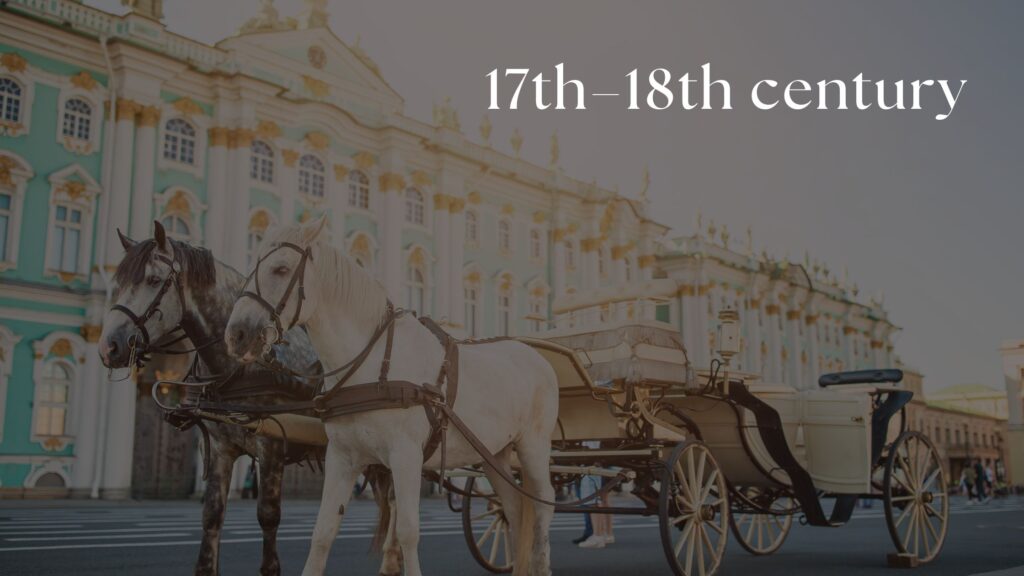
On 8 February 1611, in the presence of his mother, the queen regent, the young Louis XIII approved a decree now kept in the Archives nationales in Paris. It established a strict roll of the princes, lords and ladies permitted to enter the courtyard of the Louvre by carriage and on horseback. It opens with princes of the blood and the great dukes, then names the constable of France, ambassadors and cardinals, the captains of the royal guard, and a long list of princesses and duchesses. A short addition grants three elderly or ailing dukes, by special favour, the right to enter the Louvre by carriage at night.
The point of the document is its existence. The right to be carried into a royal courtyard was defined, written down and adjusted by royal favour for individual cases. Later accounts of court etiquette add the corollary that everyone else left the carriage at the gate and continued on foot or by sedan chair. In the Versailles of Louis XIV, one architectural record notes, the innermost royal courtyard was separated from the ministers’ courtyard by a grille and reserved for royal carriages.
It is reasonable to read this as rank made visible, since anyone standing in the courtyard could see who had the right to arrive on wheels. That is an interpretation; what the surviving papers establish is the rule, not the spectator’s experience. They also say almost nothing about how the rider felt about the ride. In this arrangement the meaning of the journey belonged to the sovereign.
The Luxury Train and the Experience of Travel
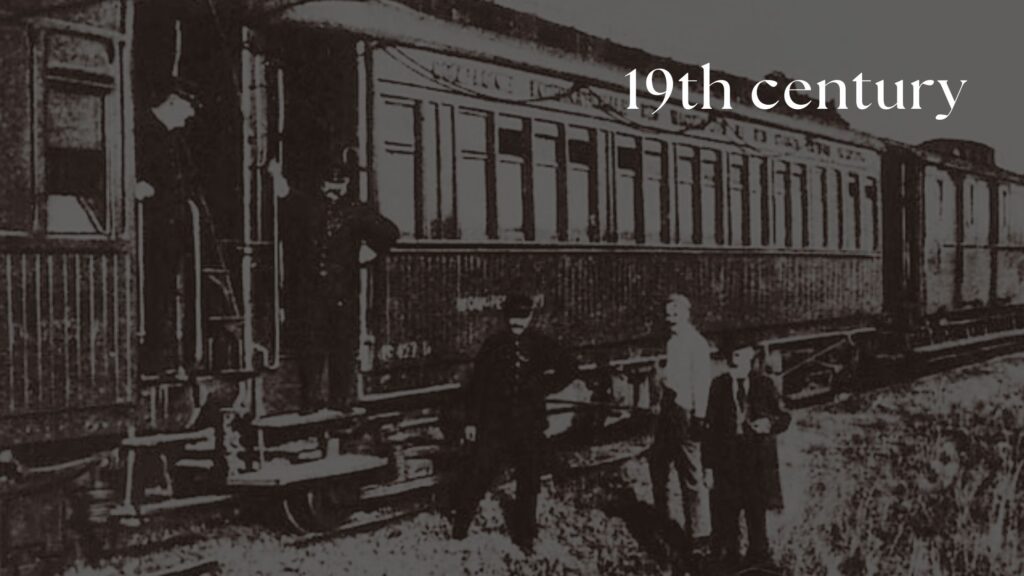
By the middle of the nineteenth century the railway had changed the question. Commentators in the 1840s and 1850s spoke constantly of the “annihilation” of time and space, a theme the historian Wolfgang Schivelbusch later made central to his study of the railway journey. For many passengers, what disappeared was the journey itself. In 1883, the French novelist Edmond About—who still remembered the stagecoach—described the ordinary railway traveller as a living parcel. Passengers were jolted by the carriers, woken by ticket inspectors, overcharged at station buffets and shut into eight-seat compartments where only four people were comfortable. He wrote this while describing a different kind of train.
That train was the service now remembered as the Orient Express, run by the Compagnie Internationale des Wagons-Lits, which the Belgian engineer Georges Nagelmackers founded in the early 1870s. The American precedent was George Pullman, whose first luxury sleeping car dates from 1865 and whose company sold its European interests to Nagelmackers in 1888; sources disagree about how much Nagelmackers owed to Pullman’s example. About’s account preserves an observation by the engineer David Banderali, made in a lecture that spring: European railway carriages descended from the sedan chair set on wheels, while American cars began as a house reduced to fit the rails.
The Paris–Vienna service that would become the Orient Express began on 5 June 1883. The run that made its reputation left Paris on 4 October with some forty guests, among them officials, railway directors, engineers and journalists. It went by rail to Giurgiu in Romania, crossed the Danube by ferry, took another train to Varna on the Black Sea and finished by steamer to Constantinople. A direct train without transfers did not leave Paris until 1 June 1889.
About describes cars of teak and crystal, heated by steam and lit by gas, which he calls rolling houses. The company introduced the national dishes and wines of the countries along the route, so that the journey unfolded as a sequence of places. He suspected that Nagelmackers had parked an old sleeping car beside the new train to sharpen the contrast. Almost everything we know about the first run comes from guests of the company, About and Henri Opper de Blowitz of The Times among them, and according to one history of the train, Nagelmackers made a habit of inviting journalists. Part of the glamour was written by those it carried. By 1890 Pierre Loti was complaining of European tourists “disgorged by the Orient Express” in Istanbul.
The experience had limits. On the Black Sea crossing, About noted, the same steamer carried Turkish peasant families packed on deck and in the hold.
Whether the luxury train was designed as an answer to the living-parcel complaint is something the sources do not say. They show that the comparison was available, and that the guests reached for it. The meaning of the journey had passed from the sovereign to a company, which offered it to those who could pay.
From Aristocratic Privilege to Wider Publics
The designed journey did not stay exclusive. Thomas Cook, already known for organised railway excursions, was running steamers on the Nile by the 1880s, turning a winter cruise there into one of the glamorous social events of the season. About himself likened his fellow guests to the docile clients of the Cook agency. Britannica notes that the pleasure cruise was a distinct tourist experience before the First World War, and that transatlantic lines were competing for middle-class passengers in the 1920s and 1930s. In the United States, the postwar family road trip made the drive itself a national ritual, though not on equal terms for everyone: Black travellers in the segregation era relied on guides such as the Green Book. Each of these stories deserves its own telling. Here they mark how an idea that began as privilege reached wider publics.
The Journey as a Chosen Experience
In 1987 the Council of Europe named the pilgrim routes to Santiago de Compostela its first Cultural Route. Until then, one academic study notes, the Camino was an obscure pursuit, with about 2,000 pilgrims arriving that year. UNESCO inscribed the Camino Francés in Spain in 1993 and the routes in France in 1998. In 2015, it extended the Spanish listing to the northern routes. In 2025 the Pilgrim’s Office in Santiago issued 530,987 Compostela certificates, a record and 6 per cent more than the year before.
That figure counts certificates, not walkers, and the certificate requires walking at least the last 100 kilometres. Compilations of the Office’s data show Sarria, a little over 100 kilometres from Santiago, as the most popular starting point, with about three in ten pilgrims, while around 6 per cent walk the full Camino Francés from the French border. The reasons people give are mixed. By the Office’s own categories, as reported, nearly half cite religious motives alone, about a third religious motives together with others, and around a fifth non-religious ones. A 2025 survey of pilgrims on the Camino Francés in Castilla y León found enjoyment of landscape and nature rising and religious or spiritual reasons falling. Scholars describe the route as at once spiritual, cultural, touristic and sporting.
The Camino therefore illustrates the argument in an awkward but instructive way. Walkers choose it for their own reasons, as the Grand Tourists did. But the route they choose was revived, mapped and certified by institutions, and many begin close to the minimum distance the certificate requires.
A Global Model in the History of Travel
The model has travelled. In Japan, the Kumano Kodō, a network of pilgrimage paths shaped by Shinto and Buddhist traditions in the Kii Mountains, was inscribed by UNESCO in 2004. In 2015 the cities of Tanabe and Santiago de Compostela launched the Dual Pilgrim programme, which recognises those who complete a route in each country.
A roll drawn up in 1611 decided who could ride into a royal courtyard. A credential issued four centuries later records who has walked to shrines on two continents. Between them, the authority to give a journey its meaning passed from the court to the company and, in large part, to the traveller, though never completely. The Camino’s pilgrims choose their route freely, yet the route reached them through heritage listings and a certificate that sets a minimum distance. Whether such a journey is chosen or offered is not easy to say, and it may be both.
Sources
Edmond About, De Pontoise à Stamboul (Paris: Hachette, 1884), chapters I–VI. Project Gutenberg: https://www.gutenberg.org/ebooks/69794 (French; translations are ours).
Ueli Gyr, “The History of Tourism: Structures on the Path to Modernity,” European History Online (Leibniz Institute of European History), 2010: https://eclass.uth.gr/modules/document/file.php/PRD_P_111/%CE%9A%CE%B5%CE%AF%CE%BC%CE%B5%CE%BD%CE%B1%202020%2021/Ueli%20Gyr%20The%20History%20of%20Tourism%20-%202010-en.pdf
Centre de recherche du château de Versailles, “Personnes autorisées à entrer en carrosse et à cheval dans la cour du Louvre – 1611” (Archives nationales, KK 544, fols. 193r–195r), transcription by Alice Camus: https://chateauversailles-recherche.fr/IMG/pdf/33._entrer_en_carosse_et_a_cheval_cour_du_louvre_1611.pdf
“Passenger Mobility,” Railroads and the Making of Modern America, University of Nebraska–Lincoln: https://railroads.unl.edu/views/item/pass_mob.html
Pullman State Historic Site, “The Pullman Company”: https://pullman-museum.org/theCompany; National Park Service, “The Pullman Car Shops”: https://nps.gov/pull/learn/historyculture/the-pullman-car-shops.htm
Encyclopaedia Britannica, “Orient-Express”: https://www.britannica.com/topic/Orient-Express; “Tourism”: https://www.britannica.com/topic/tourism
National Geographic History, “More than just a mystery train, the Orient Express whisked the elite across Europe in luxury and style”: https://www.nationalgeographic.com/history/history-magazine/article/more-than-just-a-mystery-train-the-orient-express-whisked-the-elite-across-europe-in-luxury-and-style
Australian National Museum of Maritime history, “Cook’s Nile services”: https://collections.sea.museum/objects/144226/cooks-nile-services
PBS American Experience, “The American Road Trip”: https://www.pbs.org/wgbh/americanexperience/features/american-road-trip
Council of Europe, “Santiago de Compostela Pilgrim Routes”: https://www.coe.int/web/cultural-routes/saint-james-way; UNESCO World Heritage Centre, “Routes of Santiago de Compostela”: https://whc.unesco.org/en/list/669-617
Dani Schrire, on the reanimated Camino, Ethnologia Europaea 36:2: https://ee.openlibhums.org/article/1008/galley/1154/download
Junta de Castilla y León, Perfil del peregrino 2025: https://www.turismocastillayleon.com/es/espacio-profesionales/estudios-estadisticas/estudio-ocupacion-albergues-camino-santiago-frances.ficheros/458986-PERFIL%20DE%20PEREGRINO%20-%202025.pdf
Shima Ohara, “The Kumano and Santiago Pilgrimage Routes: A Comparison of Dual Pilgrim”: https://ehime-u.repo.nii.ac.jp/record/2001320/files/AA12748373_2021_12-22.pdf; Wakayama Prefecture, “World Heritage: Kumano Kodo Pilgrimage Routes”: https://visitwakayama.jp/en/stories/kumano_kodo
Further Reading
Wolfgang Schivelbusch, The Railway Journey: The Industrialization of Time and Space in the Nineteenth Century (University of California Press, 2014 edition).
Eric Zuelow, A History of Modern Tourism (Palgrave Macmillan, 2015): https://doi.org/10.1007/978-0-230-36966-5
François Bluche, Les honneurs de la cour (Paris, 1957).
Nicolas Besongne, L’État de la France (1674), on the order of those entitled to enter the Louvre by carriage, published by the Centre de recherche du château de Versailles: https://chateauversailles-recherche.fr/IMG/pdf/roi1674.pdf
Norbert Elias, The Court Society (1969; English translation 1983).
Oficina del Peregrino, pilgrim statistics: https://oficinadelperegrino.com/estadisticas/