There is a scene in every incentive program that planners know well: the opening dinner. Guests sit at round tables, cocktails in hand, smiling at people they may not know. The venue is beautiful. The food will be good. But nothing has happened yet — no emotion, no shared reference point, no reason to remember this night over any other.
The problem isn’t execution. It’s architecture. Most events are designed around logistics rather than meaning. And without meaning, even the most technically perfect program evaporates within weeks of the attendee returning home.
What separates programs that leave a mark from those that don’t isn’t budget. It’s narrative. Specifically, the kind of narrative that humans have used for thousands of years to make sense of their world: myth.
Why myth works — and why it isn’t decoration
Mythical narratives are not stories about gods and monsters. They are structural frameworks — templates through which cultures explain transformation, challenge, belonging, and purpose. The hero’s journey, the trial of endurance, the return transformed: these patterns appear across every civilization because they map something true about human experience.
When applied to event design, they do something that no agenda template can: they give attendees a role. Not spectators. Participants in something larger than a quarterly target.
“The most effective incentive programs don’t just reward performance — they reframe it. Myth gives you the language to do that.”
The ITI 2025 Survey (IRF + SITE Foundation, n=2,708) confirms what experienced planners already sense: group cultural sightseeing experiences rank as the most appreciated program activity at 60%, followed by group dining (58%) and relationship-building activities (53%). Attendees want context, not just content. They want to feel part of something — which is precisely what a well-constructed narrative delivers.
Three mythic archetypes and how they translate to program design
These aren’t metaphors to drop into a welcome speech. They are structural frameworks that shape how a program unfolds from arrival to departure.
1. The hero’s journey — transformation
In 1949, American scholar Joseph Campbell published The Hero with a Thousand Faces, a study of stories from cultures across the world — Greek myths, Buddhist tales, Native American legends, medieval epics. His finding was simple and striking: underneath the surface differences, almost every culture tells the same essential story. A person leaves their familiar world, faces an unknown challenge that forces them to grow, and returns home changed. Campbell called this the monomyth, or the hero’s journey.
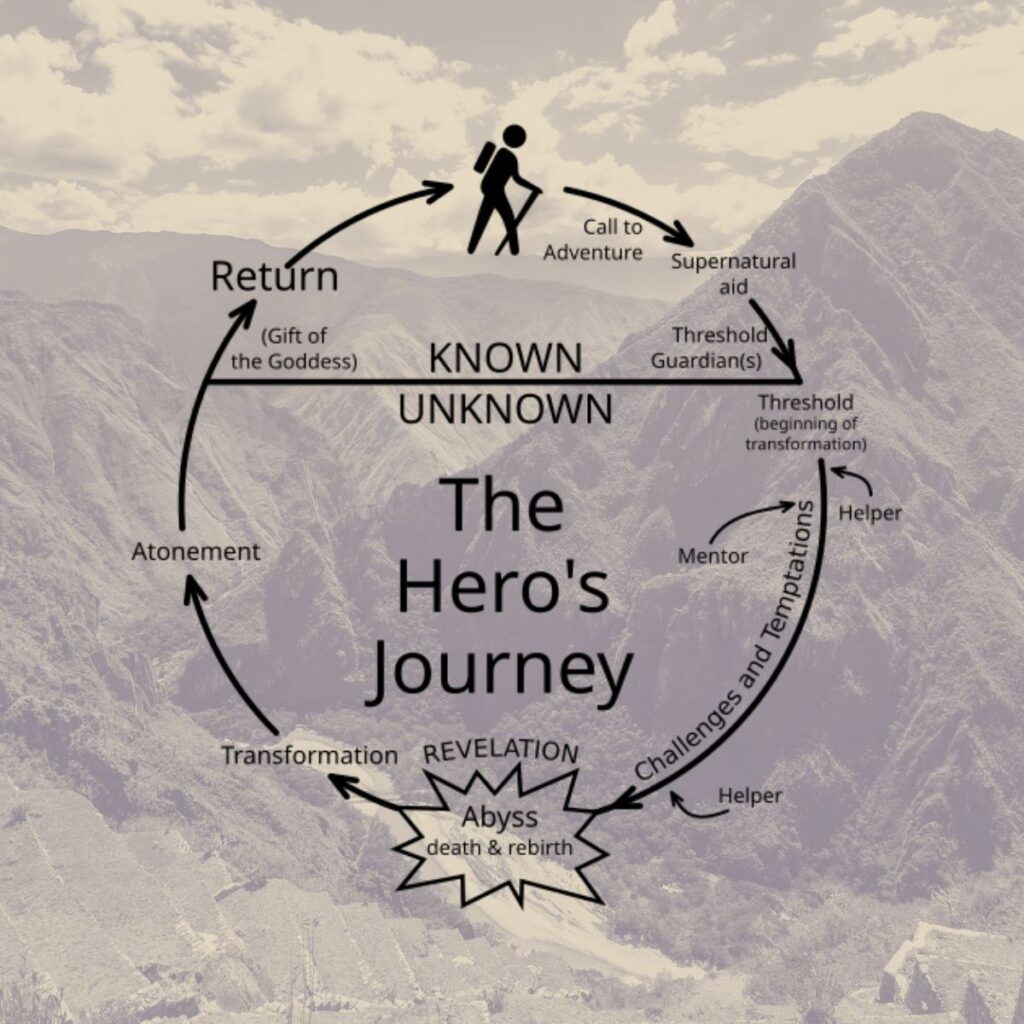
You already know this story. It’s Odysseus sailing home after the Trojan War. It’s Simba leaving Pride Rock and returning as king. It’s every astronaut, every explorer, every salesperson who hit a number they didn’t think they could hit. The shape is universal because the experience is universal.
For an incentive program, this maps with unusual precision: the qualifier leaves their ordinary working world (departure), is immersed in an unfamiliar setting that challenges and rewards in equal measure (initiation), and returns with a story and a changed sense of themselves (return). The destination is not the backdrop — it’s the threshold. This is why places with genuine physical and atmospheric drama — Iceland’s volcanic landscapes, the high-altitude silence of the Peruvian Andes, the layered history of Sarajevo — work so powerfully for incentive programs. They signal, without a word of explanation, that participants have crossed into somewhere different. Something is expected of them here.
2. The founding myth — belonging
Every culture has a story of origin — a moment when a group became a group. These stories don’t just explain the past; they encode the values the community decided to build on. Courage, sacrifice, ingenuity, solidarity. When a planner designs an event around a destination’s founding myth, they are borrowing a structure that tells attendees: what you are doing here has precedent. It matters.
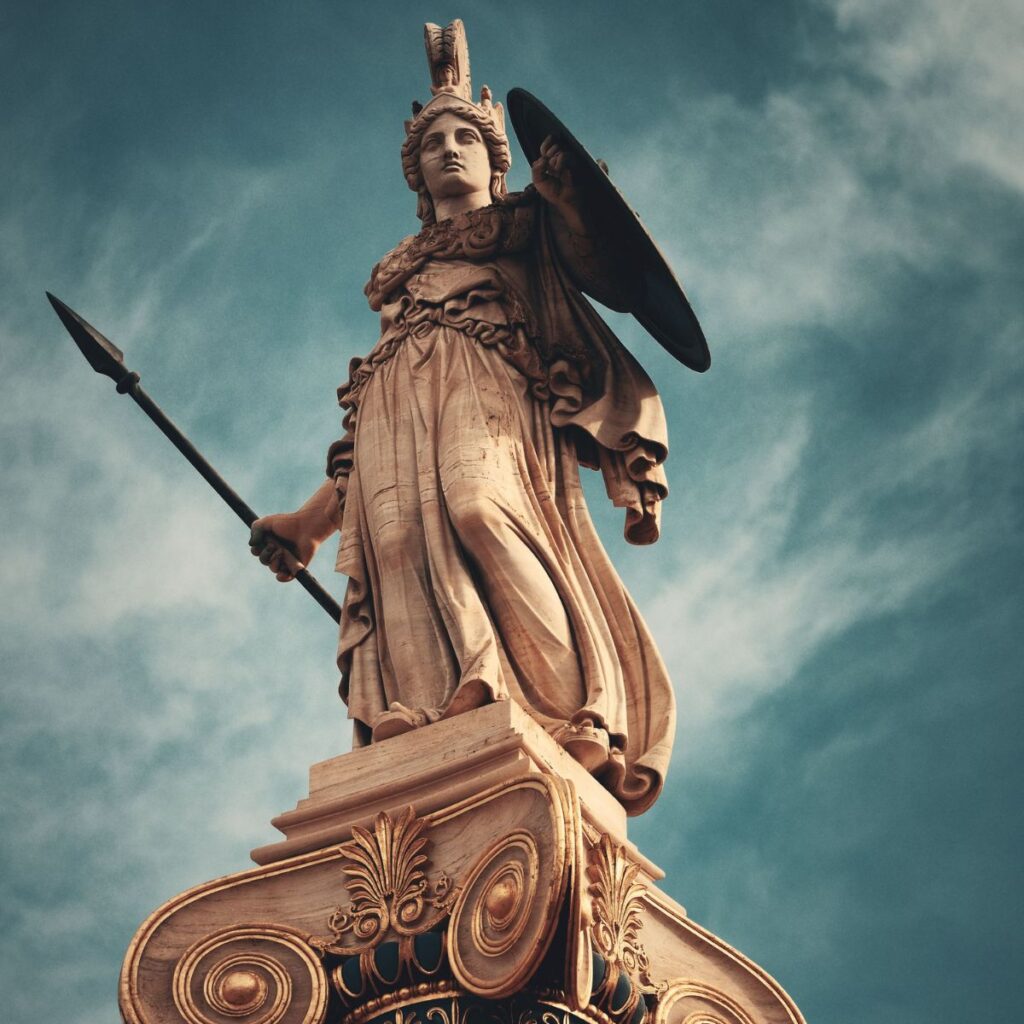
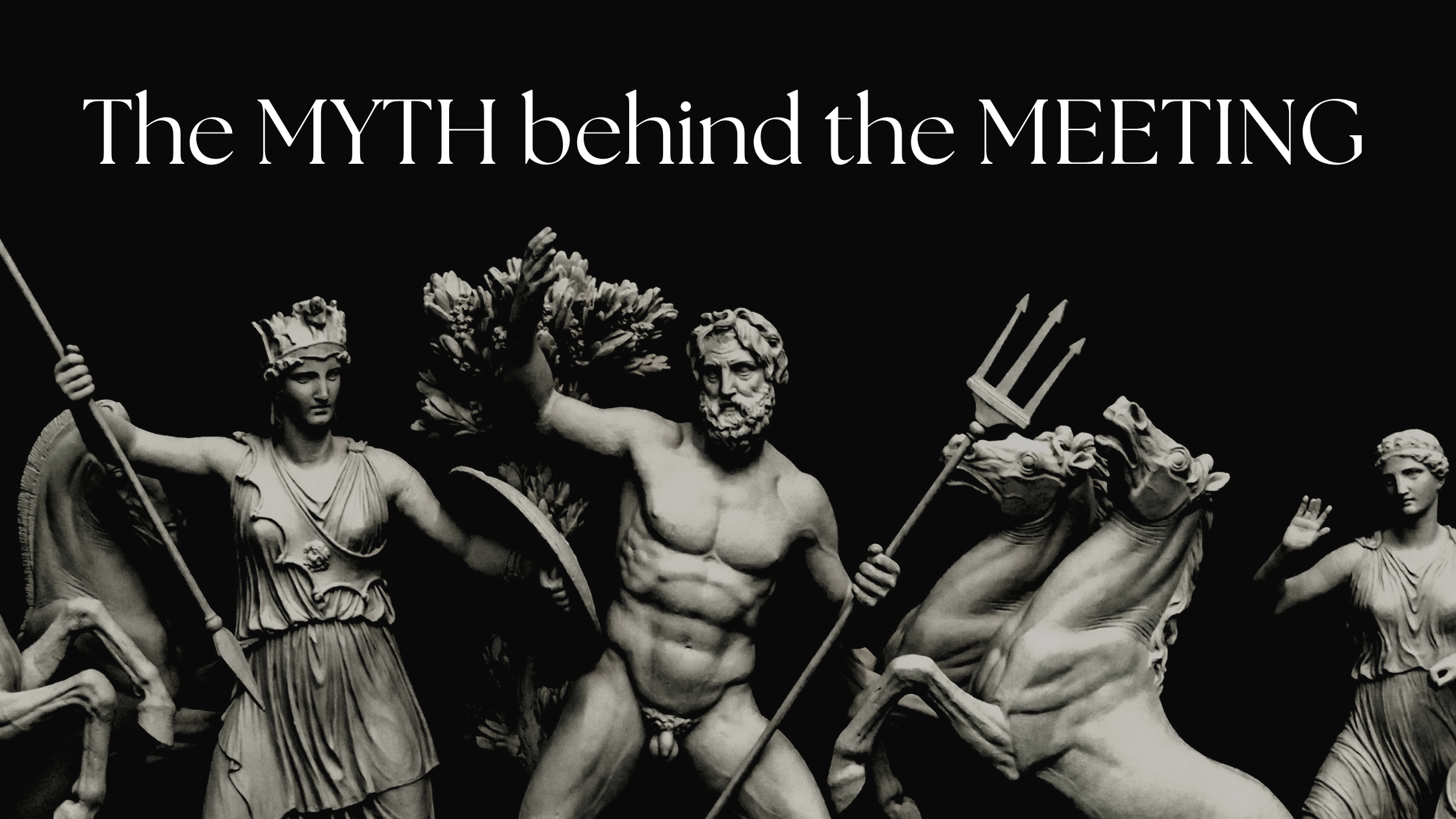
Take Athens as a working example. The city’s mythological founder is not a king or a warrior — it’s Athena, goddess of wisdom and craft, who won the patronage of the city by offering its people the gift of the olive tree: sustainable nourishment over short-term power. Designing a leadership offsite or strategic conference in Athens around this narrative isn’t difficult — the city hands you the framework. Discussion sessions framed as collective deliberation. Meals centered on local ingredients with roots in ancient agricultural practice. A visit to the Agora, where Athenian citizens gathered to debate and decide. The myth doesn’t decorate the program. It structures it.
Other destinations offer equally strong founding narratives: Kyoto’s identity as the keeper of Japanese cultural continuity when Tokyo became the seat of imperial power; the Andean concept of the four suyus — the four territories united under a single moral order — that underpins the history of Cusco; the Ottoman layering of Istanbul, where three empires built on the same ground without erasing each other. Each of these is a story about how a group decided what it stood for. That’s the same question at the center of any leadership program worth running.
One essential note here: working with a destination’s founding myth requires genuine respect, not theatrical borrowing. The stories belong to the people who carry them. A local cultural guide, a historian, or a community partner is not optional — they’re what separates a program that honors a place from one that exploits it. The more specific and credible your source, the more powerful the narrative. And the less likely you are to inadvertently offend the very community your attendees are guests of.
3. The cosmological narrative — scale and purpose
Some mythic frameworks don’t tell a story of heroes or founders. They situate human beings within a larger order — the relationship between effort and the natural world, between individual action and collective consequence. These are cosmological narratives: frameworks of scale.
Peru’s Sacred Valley offers one of the most operationally accessible examples. The Andean concept of ayni — often translated as reciprocity, the principle that what you give returns to you, and that the health of the community depends on the balance of exchange — is not an abstract philosophy. It’s embedded in the architecture of Machu Picchu, in the terrace farming systems that fed millions without depleting the land, in the textile traditions where every pattern carries a coded meaning about the relationship between maker, community, and territory. A program designed around ayni doesn’t need to explain the concept in a plenary session. It can embody it: a community CSR component where the group contributes something real and tangible to the local economy; meals sourced from producers the group has met; a closing ceremony led by a local community member, not an outside facilitator.
Similar frameworks exist across destinations with strong indigenous or pre-modern cosmologies: the Japanese concept of satoyama — the cultivated borderland between village and wilderness — which underpins the cultural landscape of rural Kyoto and Nara; the Balinese concept of Tri Hita Karana, the three causes of wellbeing, which structures the relationship between people, nature, and the spiritual world in ways that translate directly into program design for wellness or purpose-driven groups.
For companies with genuine ESG commitments or purpose-beyond-profit positioning, this archetype creates emotional resonance that cash incentives structurally cannot. It answers a question that increasingly matters to qualified attendees: why does what I do matter?
From framework to execution: a practical architecture
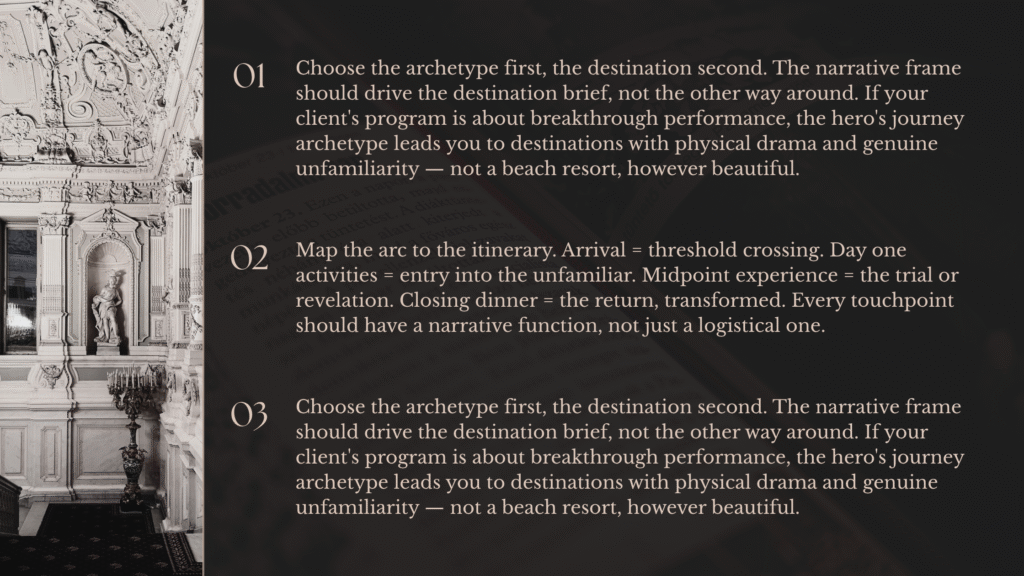
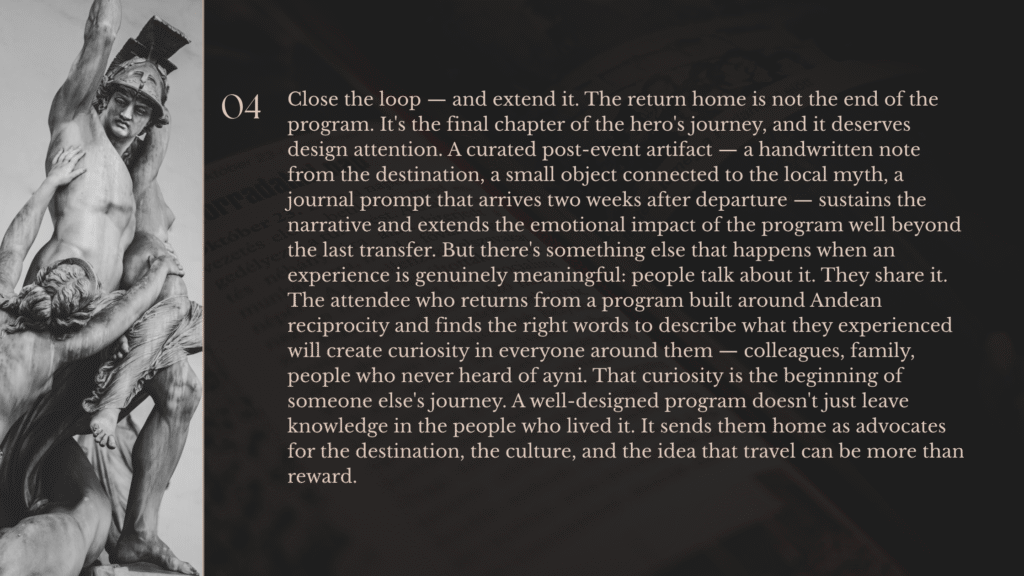
The gap between “we want a mythically-themed program” and an event that actually works is where most attempts at this fail. The problem is usually surface application: a Greek mythology gala that’s really just togas and columns, with no structural narrative underneath. A mythic program is built in four layers:
The honest limitation
Mythic program design demands more pre-production time and deeper cultural literacy than standard event design. It requires a DMC partner who understands narrative, not just logistics. It will not work for every client — a sales kickoff for a distribution company may not need a cosmological framework. And applied carelessly, it tips into cultural appropriation rather than cultural appreciation.
The filter is simple: does the narrative serve the attendees’ experience and honor the destination’s community, or does it serve the planner’s desire to be creative? The former is strategy. The latter is costume.
When it works — and in the right hands, it reliably does — mythic event design doesn’t just produce programs that attendees remember. It produces programs that attendees tell stories about. Which is, ultimately, the point.
Sources: ITI 2025 Survey Highlights, IRF + SITE Foundation + Oxford Economics (n=2,708 respondents, 85 countries, October 2025). Campbell, J. (1949). The Hero with a Thousand Faces. Pantheon Books.